THE
NEURO
CENTRE
NEUROFEEDBACK & PSYCHOTHERAPY
“Beyond words,
regulation begins.”

Neurofeedback

Neurofeedback is a way of helping the brain learn to regulate itself more effectively. It works by giving the brain real-time feedback about its own activity, allowing it to recognise what it is doing and gradually make adjustments in the background.
You do not have to consciously control anything or work out what your brain is doing. Much of this learning happens outside conscious awareness.
Neurofeedback is neuroscience, not snake oil or mumbo jumbo.
It is a scientifically established and well-researched approach that has been studied for decades and is supported by a substantial body of research.
Research has explored neurofeedback across a wide range of areas, including ADHD, autism, anxiety, sleep difficulties, PTSD, complex and developmental trauma, emotional dysregulation, dissociation, chronic pain, and difficulties with attention, memory, planning and organisation.
ILF neurofeedback is also used in trauma-informed work with clients who have experienced attachment disruption, separation and adoption-related trauma.
Beyond words
As psychotherapists, we aim to help our clients understand why they respond the way they do in challenging or triggering situations. We explore patterns, triggers and where those responses may come from.
But understanding a pattern does not always mean clients are able to change those responses.
Sometimes the nervous system continues to react in the same familiar way, even when clients understand their patterns very well. That is one of the reasons I trained in neurofeedback.
It gives me another way of helping clients regulate their nervous system alongside psychotherapy, giving the brain the opportunity to practise regulation itself.
In this way, the work can move beyond words, and regulation can begin.
First steps
If you are interested in trying neurofeedback, I will first send you a link to a detailed questionnaire which you can complete online, in your own time and free of charge.
Once I have reviewed it, we meet for a full assessment and anamnesis, which usually takes around two hours. We talk through what you are experiencing, what you would like to change and what we would like to focus on with neurofeedback.
As part of the assessment, I also use a Continuous Performance Test to look at areas such as attention, concentration and response consistency.
Assessment · approximately 2 hours · €150
Neurofeedback session · 50 minutes · €70
Psychotherapy session · 50 minutes · €70

A typical session
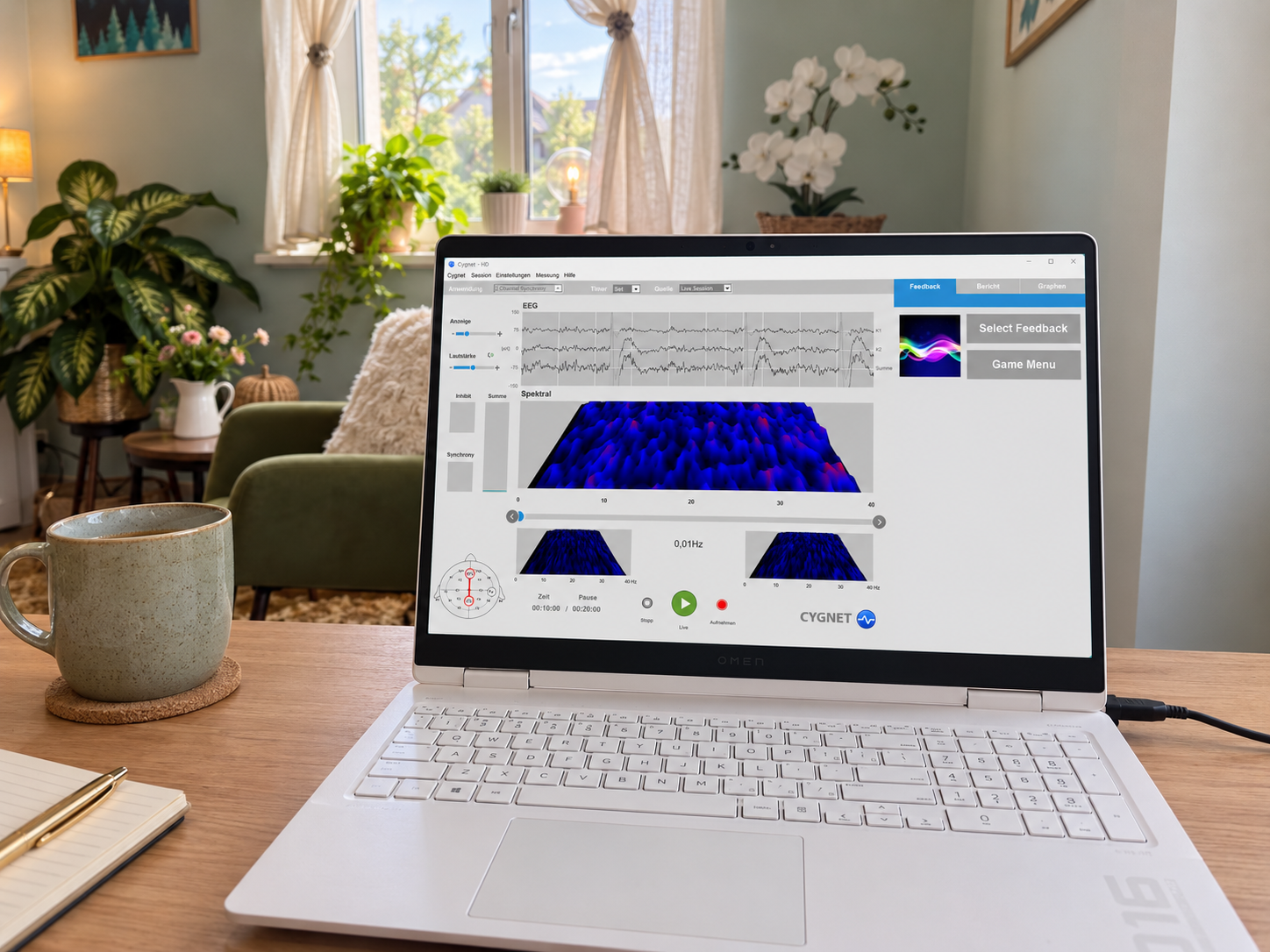
You come into my practice and settle into a comfortable chair. I place five small sensors on your head. These are connected to a computer and simply pick up information about your brain activity.
While you relax, you watch an animation on the screen. The animation changes in response to what your brain is doing, so your brain receives information about its own activity in real time.
You do not have to work anything out or try to control your brain. You can simply sit back and watch.
We always start by looking at how you have been since your last session and what, if anything, has changed.
This might be something in your sleep, mood, focus, stress levels or simply how you have been feeling in everyday life. Even small changes can be important.
Your feedback helps me understand how your nervous system is responding and whether the training should stay the same or be adjusted.
Step by step
In the beginning, neurofeedback is usually recommended twice a week. As regulation becomes more stable, the gaps between sessions can gradually become longer.
Neurofeedback is a gradual process. At the beginning, we often need to work through specific starting placements and protocols before we can move towards the areas that are most closely connected to your main concerns.
The training is adjusted as we go. What you notice between sessions helps guide the next step.
Some people notice changes relatively early, while for others the process develops more gradually.
The aim is not to rush the nervous system, but to give it repeated opportunities to practise regulation.